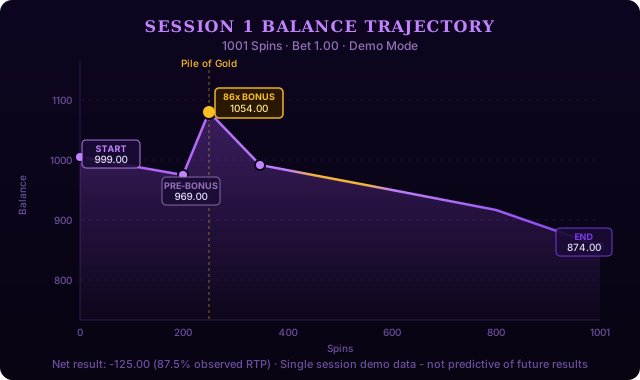























Royal Coins 2: Hold and Win is a 3x3 Hold and Win slot from Playson B.V., released on 22 September 2022. The game uses 5 fixed paylines and a reported RTP of 95.64%, with a max win of 4030x and four fixed jackpots scaling with bet size. I ran 1001 spins of the demo version and tracked balance checkpoints from start to finish - across that single session, one bonus triggered via the Pile of Gold feature and paid 86x, which was enough to temporarily reverse a 30-unit drawdown before the balance resumed its gradual decline. The most visible design choice Playson made here is restricting Bonus symbols to reels 1 and 3 only, which makes natural 3-symbol triggers rare and hands the primary trigger role to the Pile of Gold mechanic - a system where any single bonus symbol landing in the base game has a chance to force-fill the grid and launch the Bonus Game automatically. There is no Buy Bonus option, no gamble feature, and no free spins: what you get is a stripped-back Hold and Win loop where the Royal Bonus collector on reel 2 is the single mechanism responsible for most of the game's win potential.
How the Base Game Works
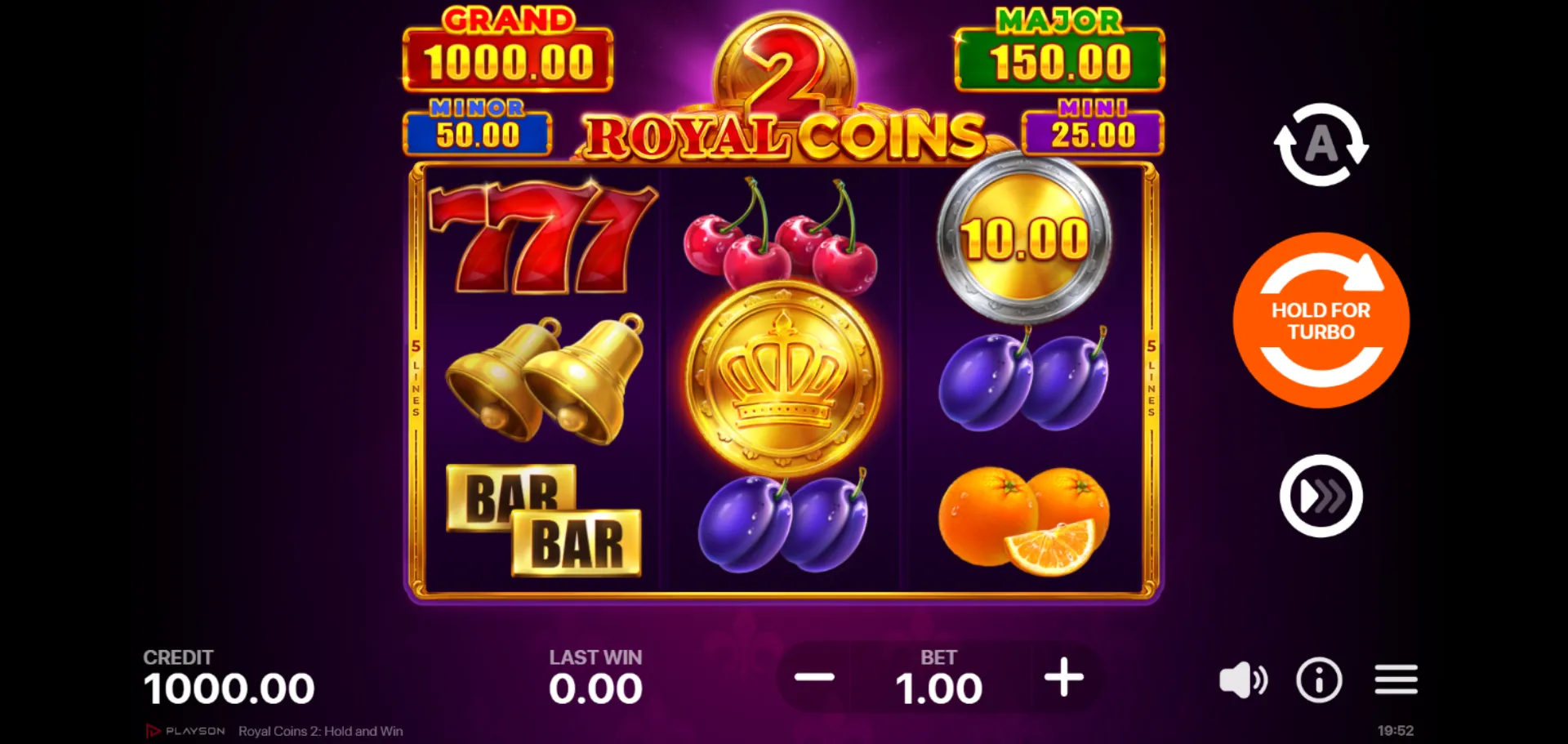
The base game runs on a 3x3 grid with 5 fixed paylines that pay left-to-right from reel 1. With only 9 symbol positions and 5 lines, the math here is transparent in a way that variable-payline setups are not - there are no hidden paths to calculate, no ways-to-win ambiguity. That simplicity is deliberate. Playson's "Timeless Fruit Slots" design language leans on classic arcade aesthetics: cherries, lemons, oranges, watermelons, grapes, BAR, bells, and the red 777 Wild, all rendered against a dark purple background with a gold reel frame. The "5 LINES" label is printed directly on the left and right edges of the reel frame and stays visible throughout play - a visual reminder that you are not dealing with a complex payline structure.
Symbol payouts at bet 1.00 are tiered in a clear pyramid: Wild (777) at 50x is the highest base-game symbol, followed by Bells at 30x, BAR at 20x, Watermelon and Grapes both at 16x, Oranges and Lemons both at 4x, and Cherries at 1x - exactly returning the bet cost. The Wild substitutes for all symbols except Bonus and Royal Bonus, which means it contributes to regular payline wins but plays no role in the bonus mechanic. Cherries returning exactly 1x the bet means losing spins are not a total wash when three land - but the contribution barely registers in a session's overall math.
In practice, most spins at high volatility produce nothing. The reported hit frequency of 10.16 - meaning approximately 1 in 10 spins produces any win - comes from a single third-party source (Fluffy Spins) and has not been confirmed by Playson. Based on the session data I tracked, this figure felt consistent: the most common positive events were 1.00 (cherries) and 4.00 (oranges or lemons), with higher-value wins appearing far less often.
Bonus Symbols: Reel Restriction and Natural Trigger Rarity
The Bonus symbol - a golden coin - appears only on reels 1 and 3. The Royal Bonus symbol - a gold crown coin, visually distinct with an ornate crown emblem and a fiery aura when active - appears only on reel 2. This position restriction is the defining constraint of the game's math. For a natural 3-symbol bonus trigger (requiring all three Bonus symbol positions to fill), you need reel 1 and reel 3 to both show Bonus coins in the same spin. The probability of that combination is low enough that in roughly 1000 tracked spins during session 1, I observed zero natural triggers - every bonus game that session came via the Pile of Gold feature instead.
The game rules extracted from the help screen are unambiguous: "3 Bonus symbols trigger the Bonus Game. Pay only during the Bonus Game. Lands on reels 1 and 3 only." The third position for the trigger is the third Bonus symbol, which must also land - the grid layout means reel 2 does not carry Bonus symbols in the base game, only the Royal Bonus. This means a natural trigger requires two reels working simultaneously in a narrow window, which the game compensates for by providing the Pile of Gold random trigger.
Understanding the reel restriction also clarifies what the Wild symbol cannot do: it substitutes for all symbols except Bonus and Royal Bonus. A Wild landing on reel 1 or 3 cannot stand in for a Bonus coin to help trigger the bonus game. Each trigger must be earned by genuine Bonus symbol appearances. This is a deliberate mathematical guardrail that controls bonus frequency and therefore the game's volatility profile.
The Bonus Game: How the Royal Bonus Collector Works
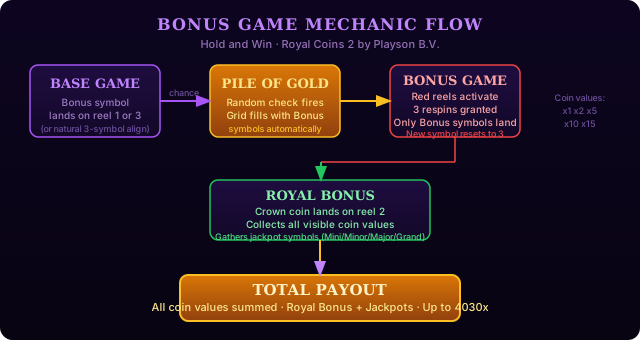
When the Bonus Game triggers - whether naturally or via Pile of Gold - the reel area takes on a deep red tint, and the re-spin counter appears at the bottom: three lit panels numbered 1, 2, 3. Only Bonus and Royal Bonus symbols land during this phase. Each new symbol that lands resets the counter back to three. The game rules state this explicitly: "3 re-spins are granted at the beginning. Only Bonus and Royal Bonus symbols land. Each new symbol resets re-spins to 3." The Bonus Game ends when the counter reaches zero with no new symbols landing, and all visible coin values are summed as the total payout.
The Royal Bonus - the crown coin on reel 2 - is the mechanic that separates a modest bonus payout from a substantial one. Per the game rules: "Royal Bonus symbols only land on reel 2 and stick. Each gathers all visible Bonus values and adds to its own value. Gathers Mini, Minor, Major and Grand Jackpot symbol values." In practical terms, this means the Royal Bonus acts as a collector: it absorbs the values of every coin on the grid at the moment it lands, then continues accumulating with each subsequent coin appearance. In session 1, I watched the Royal Bonus collector grow from zero to 46.00 as it swept adjacent coins valued at 2, 2, 5, 5, 10, 17, and 5 - a process that took roughly 6-8 respins and produced the session's largest win of 86x.
The coin values available during the Bonus Game are x1, x2, x5, x10, and x15 of the bet. At bet 1.00 that means 1.00, 2.00, 5.00, 10.00, and 15.00. In theory, a full 3x3 grid of 15x coins (excluding the Royal Bonus position on reel 2) plus a Royal Bonus collecting all of them plus a Grand jackpot symbol (1000x) is what drives the theoretical 4030x ceiling. In session 1, the most the Royal Bonus collector accumulated was 46.00 at bet 1.00, equivalent to 46x - well below the ceiling, but enough to make the bonus payout meaningful relative to the spin cost.
The Pile of Gold Feature: Base Game's Hidden Lottery
The Pile of Gold feature is the mechanism that makes Royal Coins 2 playable at realistic session lengths. Without it, the natural bonus trigger rate - requiring Bonus symbols on both reels 1 and 3 simultaneously - would be low enough to create extremely long dry runs between bonus games. The game rules describe it as: "Any Bonus or Royal Bonus symbol landing during Main Game grants a chance of triggering the 'Pile of Gold' Feature, which adds Bonus and Royal Bonus symbols enough to activate Bonus Game." In other words, every time a single Bonus or Royal Bonus symbol appears in the base game - which happens regularly - there is a background probability check running. If that check passes, the game force-fills the grid with enough bonus symbols to immediately trigger the Bonus Game.
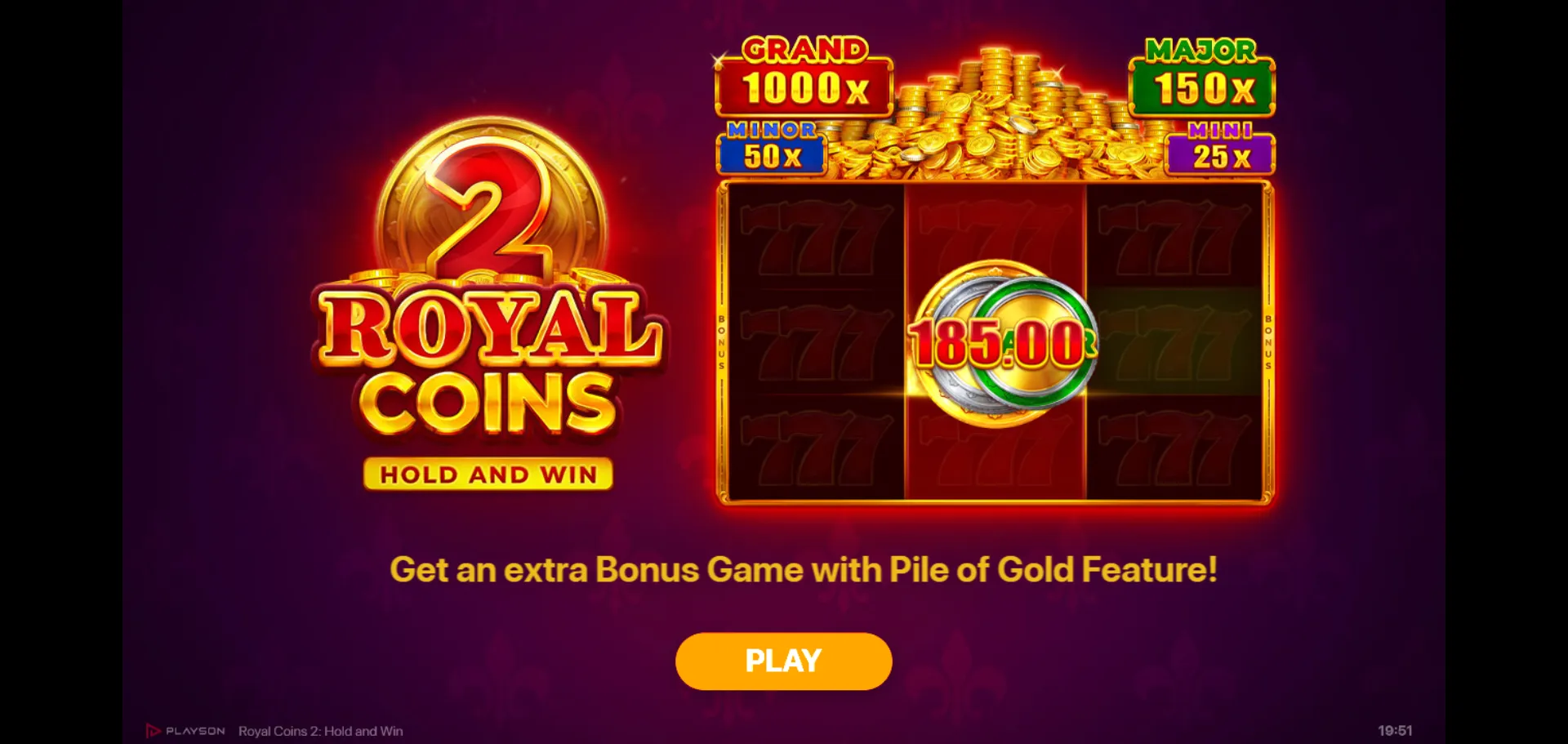
I observed one Pile of Gold activation in session 1, around frame 0045 at 16:47 CET. The animation was impossible to miss: a golden lightning or sparkle effect swept across the grid in a choreographed sequence, placing coin symbols across multiple positions before transitioning directly into the Bonus Game. The entire activation took 3-4 seconds and produced the session's only bonus trigger. The Pile of Gold was also mentioned on the game's intro splash screen - "Get an extra Bonus Game with Pile of Gold Feature!" - confirming it is positioned as a selling point rather than a minor background mechanic.
The Pile of Gold effectively replaces what other providers have solved with a Buy Bonus button. Rather than letting players pay to enter the bonus directly, Playson uses a random trigger system that fires whenever any bonus symbol appears. The probability of the Pile of Gold firing on any given bonus-symbol appearance is not disclosed in the game rules or on Playson's official page. This is a meaningful information gap for players trying to estimate expected session length between bonus games.
Jackpots: Fixed Multipliers, Not Progressive Pools
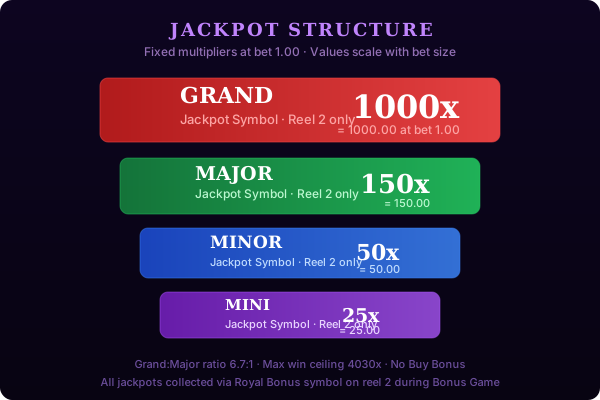
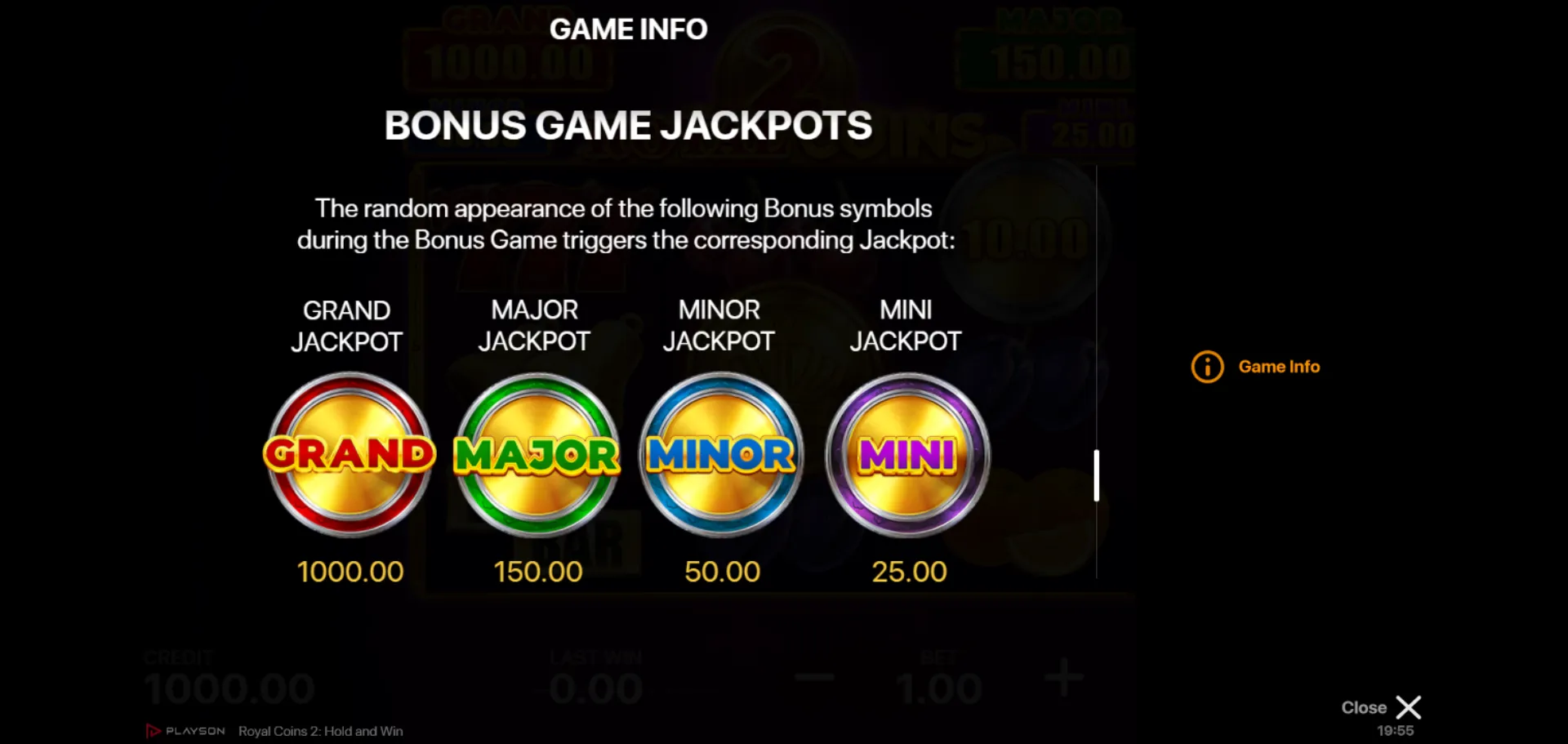
Royal Coins 2 uses four fixed jackpots: Grand (1000x), Major (150x), Minor (50x), and Mini (25x). "Fixed" here means these values are direct multipliers of the current bet, not a pooled progressive amount that grows over time. At bet 1.00, the Grand pays 1000.00, and at bet 0.80 it pays 800.00 - I confirmed this during session 2 when an accidental bet reduction from 1.00 to 0.80 changed the displayed jackpot values silently from 1000/150/50/25 to 800/120/40/20. The jackpots scale cleanly and predictably.
The four jackpots are displayed above the reels throughout the session: Grand in red, Major in green, Minor in blue, Mini in purple. They are only accessible via the Royal Bonus collector mechanic during the Bonus Game - the game rules state that the Royal Bonus "gathers Mini, Minor, Major and Grand Jackpot symbol values." Jackpot symbols can appear as collectible symbols during the Bonus Game, and when the Royal Bonus sweeps them, their fixed multiplier value is added to the collector's total.
The gap between the Grand (1000x) and the Major (150x) is a 6.7:1 ratio - a steep pyramid where the Grand tier represents the overwhelming majority of max win potential. The theoretical ceiling of 4030x likely involves a near-perfect Bonus Game with multiple high-value coins, a Royal Bonus collector, and a Grand jackpot symbol collected simultaneously. The three smaller jackpots contribute meaningfully but are not sufficient on their own to reach anything close to the ceiling. This architecture means the game's maximum payout events are extremely rare by design.
Compared to the original Royal Coins: Hold and Win, RC2 added a fourth jackpot tier (the Grand at 1000x). The original reportedly used three jackpots, which may explain why the original's max win (4259x per Casinos.com) is slightly higher than RC2's 4030x despite the additional jackpot tier - the rebalancing to fund the new Grand tier required adjusting other parameters.
Paytable: Symbol Values and the Wild's Limitations
The in-game paytable at bet 1.00 runs from 1.00 (Cherries, 3x) to 50.00 (Wild 777, 3x). That 50:1 spread across 8 symbols is a moderate range for a 3x3 slot. Watermelon and Grapes share the 16x tier; Oranges and Lemons share the 4x tier - two pairs with identical values that reduce symbol complexity without meaningfully changing the math. The significant jump is from Bells (30x) to Wild (50x): a 67% increase for the top symbol, which makes Wild combinations the most impactful base-game event by a clear margin.
The Wild (red 777) substitutes for all symbols except Bonus and Royal Bonus. This means Wilds contribute to regular payline wins - a Wild on reel 2 can complete a Bells combination across a payline, for example - but they are irrelevant to the bonus trigger. This is a design boundary that keeps the two game modes - base payline play and bonus trigger - completely separate. You cannot use a Wild to get "closer" to a bonus trigger; the only paths to the bonus are natural Bonus symbol alignment or the Pile of Gold random fire.
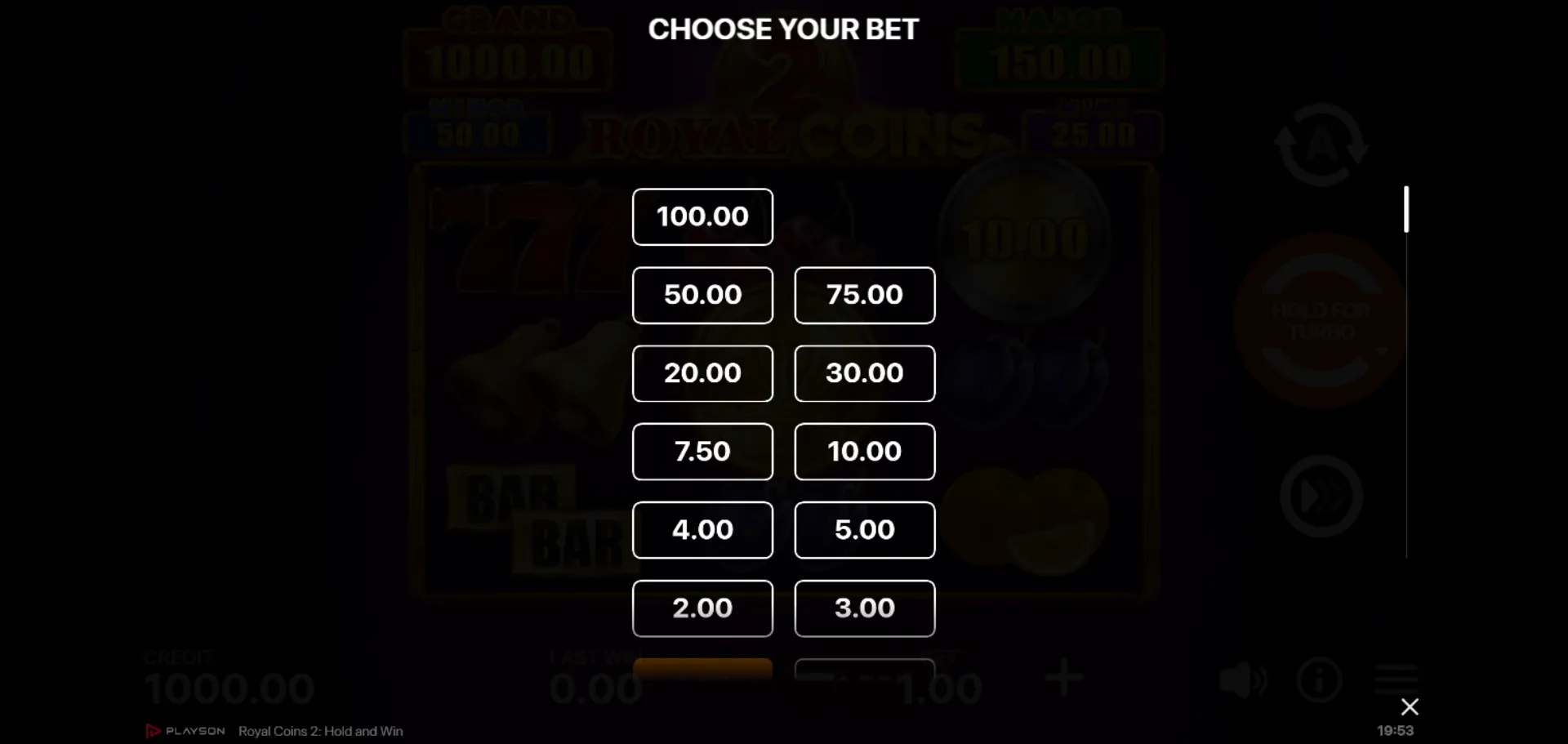
At min bet (0.10), the Wild's 3x payout is 5.00 - a 50x return per bet unit. At max bet (100.00), a 3x Wild combination pays 5000.00 (50x). The max bet is high enough that jackpot values scale to Grand 100000.00, Major 15000.00, Minor 5000.00, Mini 2500.00. These are meaningful nominal amounts, but the probability of hitting the Grand at max bet is the same as at min bet - the fixed multiplier structure doesn't change frequency at higher stakes.
All symbol payout values above are read directly from the in-game paytable on the Game Info screen, captured during the demo session - Playson does not publish a standalone symbol paytable for this title on its official game page.
Session Data: 1001 Spins, One Bonus, and What the RNG Delivered
I tracked session 1 from start (balance 999.00) to the agent-reported endpoint (balance 874.00) over approximately 89 minutes of autoplay at bet 1.00. The net result was -125.00, giving an observed RTP of roughly 87.5% for that single session. This figure is substantially below the theoretical 95.64% and is entirely expected behavior for a high-volatility slot over a sample of around 1000 spins - one more bonus trigger delivering even a 100x payout would have brought the session closer to theoretical expectations.
The session produced one confirmed bonus trigger, via the Pile of Gold feature at approximately the 150-200 spin mark (frame 0045, 16:47 CET). Balance had declined from 999.00 to 969.00 at that point - a drop of 30 units over roughly 30 spins with no wins above 4.00. The Pile of Gold animation activated, filled the grid with Bonus symbols including a Royal Bonus on reel 2, and the Bonus Game ran. The Royal Bonus collector accumulated to 46.00, and the total payout was 86.00 (86x). Post-bonus balance jumped to 1054.00, momentarily above the starting balance, before resuming a gradual decline. By session end, the balance had returned below the starting point.
The balance trajectory illustrated something important about high-volatility Hold and Win slots: the single bonus event dominated the entire session's math. Without that 86x trigger, the session would have ended near -211.00 (roughly 79% return rate, a 21% loss on total wagered) instead of -125.00. Base game wins - mostly 1.00 and 4.00 events - provided minor cushioning but had negligible cumulative impact. These figures are from a single session of demo play and should not be taken as representative of typical behavior.